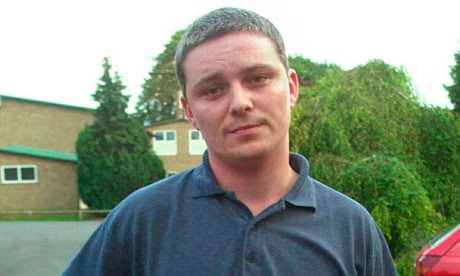
Ian Huntley: The Tragic Soham Case and Its Lasting Impact on the UK
The name Ian Huntley remains one of the most infamous in modern British criminal history. Associated with one of the most shocking crimes of the early 2000s, Huntley’s actions not only devastated families and communities but also transformed how the United Kingdom deals with background checks, school employment, and safeguarding policies. This article examines who Ian Huntley is, the events surrounding the Soham murders, his background, the trial, and the long-term societal consequences of his crimes.
Early Life and Background of Ian Huntley
Ian Kevin Huntley was born on January 31, 1974, in Grimsby, Lincolnshire, England. His early life appeared ordinary on the surface, though later investigations revealed a troubled past. Huntley was described as quiet and somewhat reserved during his school years, but he reportedly struggled with relationships and exhibited controlling behavior toward others, particularly women.
Throughout his teenage years and early adulthood, Huntley’s life was marked by instability. He left school with few qualifications and moved through various jobs, including as a caretaker and factory worker. Those who knew him described a man who appeared polite and soft-spoken, but who could also be manipulative and deceitful.
Before the events in Soham, there were already allegations against Huntley involving inappropriate behavior toward underage girls. However, these incidents never led to successful prosecutions due to insufficient evidence, gaps in record-keeping, and lack of coordination between local authorities—an issue that would later be seen as a major institutional failure.
Life in Soham and Relationship with Maxine Carr
By the early 2000s, Ian Huntley had secured a job as a school caretaker at Soham Village College, located in Cambridgeshire. He lived with his girlfriend Maxine Carr, a teaching assistant at nearby St. Andrew’s Primary School. Carr was well-liked by colleagues and students, and together, the couple appeared to lead a quiet, normal life in the small, close-knit community.
Soham, a peaceful town, was known for its traditional values and sense of security. Residents trusted Huntley as a responsible member of the school staff, which made the events of August 2002 all the more horrifying and incomprehensible.
The Soham Murders: What Happened in August 2002
On August 4, 2002, two ten-year-old girls, Holly Wells and Jessica Chapman, went missing in Soham after attending a family barbecue. The two best friends were last seen wearing matching Manchester United football shirts, smiling and enjoying their summer break. When they did not return home, their families raised the alarm, prompting a nationwide search.
The disappearance of Holly and Jessica quickly dominated national news. Volunteers, police officers, and media teams flooded the small town. Among the people interviewed on camera was Ian Huntley himself, who, posing as a concerned local, told journalists he was the last person to see the girls alive. His apparent cooperation and calm demeanor initially diverted suspicion.
However, investigators began to notice inconsistencies in Huntley’s statements. As forensic evidence mounted, suspicions grew. On August 17, 2002, the bodies of Holly Wells and Jessica Chapman were found in a ditch near an RAF base at Lakenheath, Suffolk. Both girls had been murdered.
Shortly after the discovery, Ian Huntley was arrested and charged with two counts of murder. Maxine Carr was charged with perverting the course of justice and assisting an offender, as she had provided Huntley with a false alibi.
The Trial of Ian Huntley
The trial began in November 2003 at the Old Bailey in London. The proceedings were followed closely by the British public and international media, all seeking answers about how such a tragedy could have occurred.
Huntley admitted to being responsible for the girls’ deaths but claimed they were accidental. According to his account, Holly Wells had fallen into the bath while visiting his home, and Jessica Chapman had died while trying to help her friend. The prosecution, however, presented compelling forensic evidence that contradicted Huntley’s claims.
The court heard that Huntley had deliberately lured the girls into his home and killed them. The evidence pointed to premeditated intent, and Huntley’s past—marked by a pattern of concerning behavior around young girls—further strengthened the prosecution’s case.
On December 17, 2003, Ian Huntley was found guilty of the murders of Holly Wells and Jessica Chapman. He was sentenced to two life terms, with a minimum term of 40 years—effectively ensuring he would remain in prison for the rest of his life. Maxine Carr was found guilty of perverting the course of justice and received a three-and-a-half-year prison sentence. She was released in 2004 and granted a new identity for her protection.
Public Reaction and National Mourning
The murders of Holly and Jessica deeply affected the entire nation. Thousands of tributes poured in from across the UK, and vigils were held in Soham and beyond. The image of the two girls smiling in their football shirts became an enduring symbol of innocence lost.
Many people found it particularly disturbing that the perpetrator had been someone trusted within a school environment—a setting that should represent safety and protection. The sense of betrayal and outrage prompted widespread calls for reform.
The Bichard Inquiry and Policy Reforms
In response to the public outcry and institutional failures exposed by the Soham case, the government launched the Bichard Inquiry, led by Sir Michael Bichard. The inquiry investigated how Ian Huntley was able to obtain employment at a school despite a history of allegations involving minors.
The findings revealed severe shortcomings in police information-sharing and background vetting procedures. Before the murders, Huntley had been investigated several times for sexual offenses and inappropriate conduct with underage girls, but because these allegations did not result in convictions, they were not shared between police forces or employers.
As a direct result of the inquiry, significant reforms were introduced, including:
- The creation of the Independent Safeguarding Authority (ISA) – later merged into the Disclosure and Barring Service (DBS), which oversees checks on individuals working with children and vulnerable adults.
- Enhanced background checks for those seeking employment in schools, healthcare, or care facilities.
- Improved data-sharing between police forces and local authorities, ensuring that concerns about individuals are recorded and accessible nationwide.
- Clearer child protection policies in educational institutions to identify and address risks earlier.
These changes have had a lasting positive impact, making the Soham case a turning point in the UK’s approach to safeguarding.
Life in Prison and Later Developments
Ian Huntley has remained imprisoned since his conviction, serving his sentence at high-security facilities. Reports from within the prison system suggest that he has faced hostility from other inmates and has been moved between prisons for his own safety. Huntley has occasionally been in the news for making statements or claims of remorse, but these have generally been met with skepticism by the public and victims’ families.
His minimum term of 40 years means he will be eligible for parole in 2042, at the age of 68. However, given the gravity of his crimes and the ongoing public outrage, it is considered extremely unlikely that he would ever be released.
The Lasting Legacy of the Soham Murders
More than two decades later, the Soham case remains a defining moment in Britain’s criminal history. For many, the tragedy is not only about the loss of two young lives but also about systemic failures that allowed a dangerous individual to slip through the cracks.
The case has had enduring cultural, social, and political effects:
- It reshaped safeguarding policies across all sectors involving children.
- It increased public awareness of the importance of reporting suspicious behavior.
- It strengthened community vigilance, with parents, schools, and organizations placing greater emphasis on child safety.
- It also prompted media reflection on how missing-person cases are reported and handled.
The memory of Holly Wells and Jessica Chapman continues to be honored in various ways, reminding society of the importance of vigilance, accountability, and reform.
Conclusion
The story of Ian Huntley and the Soham murders is one of profound tragedy and hard-earned lessons. It revealed deep flaws in institutional systems meant to protect children, but it also led to significant positive change that continues to safeguard countless others today.